
This month’s Player Spotlight focuses on Bonaparta, active forum participant and global chatter, player tournament enthusiast and orc-ish roleplayer. Her fellow players, as well as the GMs of Illy appreciate the spirit and enthusiasm that Bonaparta brings to the game. Learn more about the Player Spotlight program at our website and nominate players by sending an email to community@illyriad.co.uk. Now on with the interview!
GM Luna

What brought you to Illyriad and how long have you been playing?
I started playing in October 2011. My boyfriend, who also plays Illyriad, introduced it to me and I liked the complexity and slow pace. The community was a nice experience, so I stuck to the game. I also come from a country that used to be called Illyria province and then kingdom of Illyria. The name of the game seemed somehow fitting. It is also nice that boyfriend and me have the same hobby.
Have you played many other online games or been active in other online communities?
I haven’t been playing any games for more than 2 years before, because all my free time was consumed by me finishing my doctorate. The last game I played before Illyriad was Glory of Fellowland. It is nice game, but a bit too simple for my taste. I also won the first realm I played so not enough challenge there… Before that I’ve been playing games since I was 7 when my father bought me and my brothers a Commodore 64. I always liked strategy and especially strategy combined with fantasy creatures and magic. I just love games like Heroes of Might and Magic, Master of Magic, Dominions and Age of Wonders.
Any hidden talents or interesting hobbies outside of gaming?
I have a dog, 6 years old 55 kg black-brown Hovawart. I like recreational sports like skiing, squash, table tennis, cycling, climbing, skydiving and I like to run. I’m part of a group that has been pen and paper roleplaying for more than 10 years, mostly Dungeons and Dragons. In the lab I was once required to make HDR photography of a sample. I liked the results so I’m now a self-educated HDR photography maniac. Wherever I travel I make hundreds of HDR photos. I also like to photograph the night sky with help of my refracting telescope and this year I bought a waterproof camera case so I can take pictures when I dive. My family also owns quite big vineyard. I help there sometimes and I like to sample the products too.
What keeps you playing Illyriad?
Me and my boyfriend have a lot of fun. We discuss the different aspects of the game and try to excel at them. The game has the right amount of complexity. Once you reach certain size, whole new different strategies open up. The orc female character in the game is also my character in pen and paper roleplaying. I like to roleplay. Community is nice.
What’s your favorite aspect of the game?
I’m not sure I can pick a single aspect of the game that I like the most. I like the whole package. From building, trading, fighting and socializing.
What’s your proudest achievement in game so far?
Hm. Yesterday I built my 10th town, I’m proud of that. My alliance won in a quite difficult war few months back. I’m sure that I’m the toughest orcess in the game since I have 700 scrawny wolves 🙂
What are you most looking forward to for the future of Illyriad?
Hard to say. I really don’t know what the future of Illyriad will be. Even without changing any programmable aspect of the game, the community can make changes in our behaviour. It really is we players that make this game. Community can decide to play as Farmville or Evian, it’s up to us.
What area of the game do you think needs the most improvement?
Diplomatic units just don’t do anything much in the game. Combat system for diplomatic units is too simplistic and unrealistic. You can succeed or lose all units, there should be more degrees of complexity here. Thieving is fun, but now everyone will just store their valuables in faction hubs. Assassins could do more damage, saboteurs are completely useless.
Magic at this point is extremely limited. Many players including me have millions of magic points stored, unable to use them. Perhaps new magic schools, like summoning, clairvoyance, terraforming.
I’m still trying to cope with new aspects of trade, but I’m already missing two options: Trade embargo on certain player(s) or alliance(s) – I just don’t want to sell something to my enemy or market speculator. Trade only within alliance option – I really would like to set sell price in a faction hub to 0 GP for basic resources, but only my alliance or my training alliance members can “buy” them, this would simplify resource help for new players immensely. I would also set different prices for my alliance mates then for the rest of the players.
All weapons, armours and horses have % based penalties or benefits. I would also like to see not % based equipments that have like +2 attack points or +4 to all defence points. Adds more options to all crafting system and makes even the cheapest units like kobolds worth equipping. +2 attack means much for kobold, but is very poor weapon in hands of a knight. I would also like to see my caravans equipped with better horses.
New specialist military unit for each race, that would be extremely costly to train and required a lot of rare herbs or minerals or body parts. Such unit should have extremely good qualities too.
Change training times for existing units. All units should have comparable training time per EXP point.
Terrain attack and defense bonuses and penalties should be much larger. I would say cavalry is only 5% effective on high mountains not 70%. Archers in jungle can’t really shoot anything so I would make them only 1% effective and so on. This would force players to rethink their strategy not like now where vast majority are training only cavalry and archers.
More options for relationships between alliances not just confederations and NAPs. One option should be vassalage, where certain % of alliance gold income is paid to the other alliance (like alliance tax but payed to other alliance). This can be result of peace negotiations or just paying for protection or mining rights. Trade embargo option – no direct or faction hub trading possible between members of alliances that have trade embargo between them. Economic cooperation option – military units would still kill each other, but military units would not kill harvesting units.
What advice would you give a new player in Illyriad?
Don’t rush. Pace yourself, think carefully before everything that you do and have a plan. Before you make major decisions in game read forums and consult with other players. Major decisions are: Joining alliance, moving towns and settling new towns, specializing your towns and sovereignty.


 Trade is based on the notion that you swap what you do not need or do not want, for something you do need or want. For example, you want a new car and you have more money than you need, so you buy a car from a dealership which has cars but needs money. Or perhaps you are better at playing a certain sport than anyone else on Earth, so you swap your time for vast quantities of money at one of the top clubs (and then, oh, the cars you will buy!)
 Our last blog piece happened to mention Obsidian Mines. Obsidian Mines are unusual and I’ll get to explaining them in a minute. But first, let’s start with something easy, Silverthorn.
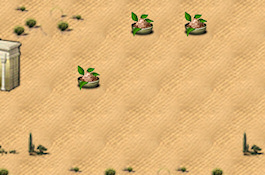 But what do you do with your Silverthorn? This is not a herb you will need every day. It isn’t used for weapon making, and you probably only want to use one piece every couple of months, at least in times of peace. There are 80-90 patches of Silverthorn on the map, each potentially yielding two dozen pieces of Silverthorn herb each day. So what do you do?
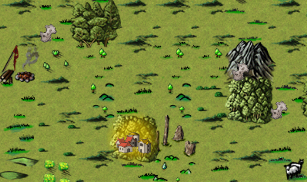 And in addition, where animals are slain patches of Hides, including rare animals parts, will be left behind (as in this image). And there are also minerals. Which brings us back to Obsidian.
 Is it Trueshots as excellent all-rounders? Of course in most cases, the best troop type is the unit best suited to the task at hand: neither Knights nor Trueshots fare well when defending in forests, for example. But pretty soon, this answer will change. It will not just be the unit type best suited to the mission, but also the unit which is best equipped for the mission.
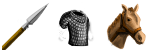 What equipment is ideal will also depend upon the exact mission, as well as a player’s strategy. For example, when sending your Dwarven Halbardiers to defend a neighbouring settlement from an unexpected attack, you may want them to carry lighter than usual equipment so that they can get to their destination as fast as possible, before the attack strikes.
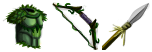 If they are to defend a wooded tournament square, then perhaps you want them to carry only shorter spears and armour adapted for woodland combat, so that they get bonuses based on that terrain.
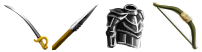 If you want the same units to defend a nearby Obsidian Mine, then you may want really heavy armour that gives a bonus in defence and Pikes to fend of cavalry raiders, and as the troops won’t move often you won’t much care how much this bulky equipment slows their movement. And so on.